
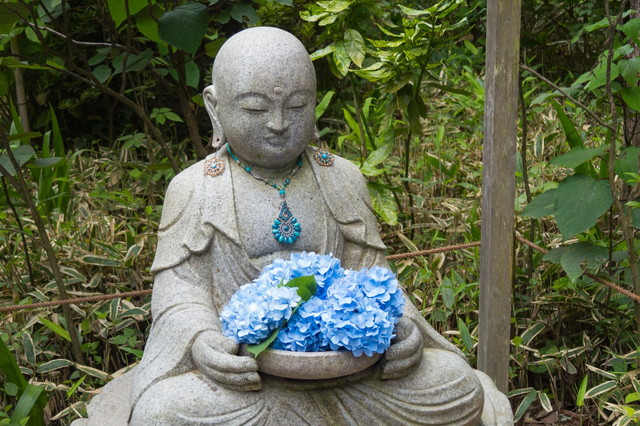
Once upon a time, in the province of Owari (Aichi Prefecture), there lived a man who had entered the priesthood and taken the name Nyudo after many years of public service. In his household was a violent man named Ki no Mochikata, the Vice-Governor of Musashi (Kanto region). Mochikata was renowned for his military prowess, but he possessed a corrupt perspective and lacked any semblance of a virtuous heart.
However, for reasons unknown, Mochikata eventually underwent a spiritual awakening and became a devoted follower of Jizo Bodhisattva. On the 24th of every month (the feast day of Jizo), he would abstain from meat and alcohol, refrain from carnal desires, and pray fervently to Jizo. Day and night, he also chanted the Nembutsu (the name of Amida Buddha), never failing to maintain his ritual purity.
Despite this, Mochikata remained naturally short-tempered. Even in the middle of a calm conversation, he might suddenly explode in a fiery rage. Because this happened so often, people treated him with cold derision. Yet, even in those moments of anger, Mochikata never neglected to pray to Jizo and chant the Nembutsu.
At that time, there was a holy man known as the “Saint of Amida,” who spent his days and nights encouraging people to chant the Nembutsu. One night, a golden Jizo Bodhisattva appeared in the Saint’s dream. Jizo said to him: “The person you encounter tomorrow on [XX] Alley is I, Jizo.”
Upon waking, the Saint was overjoyed by this divine revelation. The next morning, as he walked down the alley to spread the teachings, he encountered a layman (a commoner, not a monk). The Saint asked, “Who are you?” “I am Ki no Mochikata,” the man replied. The Saint prostrated himself before Mochikata many times, weeping with gratitude and reverence. “Perhaps it is because of the merits of your good deeds. I have finally met Jizo Bodhisattva. I beg of you, please guide me to salvation.”
Mochikata was shocked and bewildered. “I am a man of great evil and corrupt views. Why do you, a Saint, weep with joy and worship me?”
The Saint replied through his tears: “Last night, I dreamed of a golden Jizo. He told me, ‘The person you meet in this alley tomorrow morning is Jizo.’ I believed those words. Now, I have met you. You must surely be an incarnation of Jizo Bodhisattva.”
Mochikata thought to himself: “It has been many years since I began believing in Jizo. Perhaps that is why this has happened. This may be a sign from the Bodhisattva.” With those thoughts, he parted ways with the Saint.
From that day forward, Mochikata’s faith in Jizo grew even deeper. Eventually, in his old age, he entered the priesthood. More than ten years passed, and though he eventually fell ill, he suffered no pain. Maintaining a clear mind, he faced the West, chanted the Nembutsu of Amida, called upon the name of Jizo, and passed away.
It is said that all who heard of this—monks and laity, men and women alike—were moved to tears of reverence.
[Translation]
Shinichi Kusano / Siro Inuzuka
This text was created by using Gemini to translate a modern Japanese translation into English, and then making some modifications. There may be errors in the English expressions. Please correct any mistakes.
[Explanation]
Shinichi Kusano / Siro Inuzuka
The “Big in Japan” Bodhisattva
The previous story in the collection involves Jizo appearing in his divine form before a devout monk. What makes this story interesting, however, is that both the man mistaken for a god and the man making the mistake are deeply faithful in their own ways. The “victim” of the mistake is a violent, short-tempered man – essentially a “good-for-nothing” ridiculed by society. Yet, this single incident changes the entire trajectory of his life.
Strictly speaking, a “real” Jizo never actually appears in this story. That is precisely why the tale has such a profound, lingering flavor.
The seventeenth volume of the Konjaku Monogatari is a collection of “miracle tales” of Jizo. This tells us that Jizo was already a common, beloved figure 1,000 years ago, during the late Heian period.
Interestingly, in India -the birthplace of Buddhism- Jizo (Ksitigarbha) was almost never worshipped. He was a minor figure, didn’t look like a monk, and had long hair. Lacking clear, recognizable features, he simply didn’t stick in people’s minds.
Jizo only gained his iconic shaven-headed “monk” look after reaching China. His popularity began there, then crossed to Japan, where he became an absolute superstar.
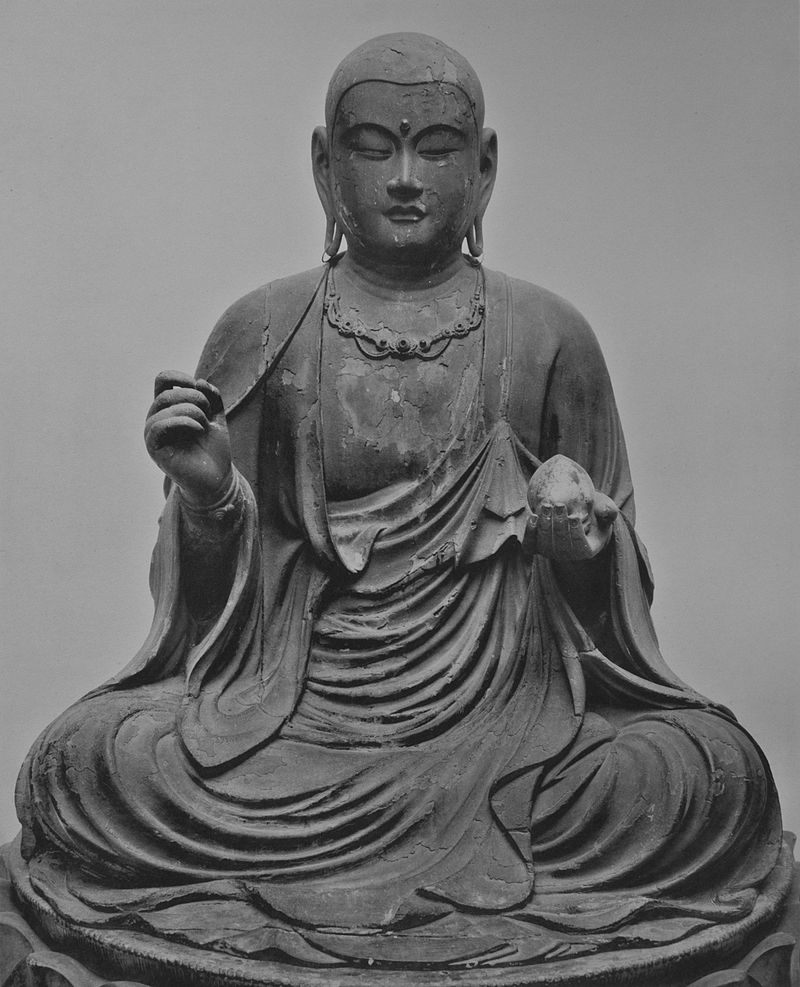
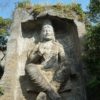
Wooden Seated Statue of Jizo Bodhisattva, Rokuharamitsu-ji Temple, Kyoto (Kamakura Period, attributed to Unkei)
It reminds me of how Paul Weller’s first solo album was originally only released in Japan. Weller didn’t become a massive star in his home country until later. Bands like Queen and Cheap Trick also found their first real sparks of stardom in Japan. At first, they were “Big in Japan” only (though many others stayed that way).
The massive craze for Jizo is a uniquely Japanese phenomenon. You’ve seen the roadside Jizo statues, right? While there are many Buddhist countries in the world, Japan is the only one that reveres Jizo to this extent.
The Japanese even created “apocryphal” sutras like the Enmei Jizo-kyo. Because he was so popular, people wanted a scriptural basis for him. They wanted to be able to say, “The Buddha said this,” but they couldn’t find a suitable quote – so they just made one themselves. Right here in Japan.
Why did he become such a hit? Why was he so deeply loved? In the figure of Jizo, we can see the reflection of the “Japanese soul.”
●Japanese



コメント