
Once upon a time, there was a man named Devadatta. He was a paternal cousin of the Buddha. Devadatta was the son of King Dronodana, who was the younger brother of King Suddhodana, the Buddha’s father.
When Devadatta was young, he shot a wild goose with an arrow. The goose flew away with the arrow still lodged in its body and fell into the garden of Prince Siddhartha (the Buddha before his enlightenment). Seeing the goose, Prince Siddhartha felt great compassion; he took the bird in his arms, comforted it, and pulled out the arrow. Devadatta came to the Prince and demanded, “What happened to my goose?”
The Prince refused to hand it over. This angered Devadatta. It is said that the rift between Prince Siddhartha and Devadatta began at this moment.
After Siddhartha became the Buddha, Devadatta studied the scriptures of non-Buddhist paths. He took great pride in his own learning, grew jealous of the Buddha, and challenged him many times.
Once, while the Buddha was preaching at Vulture Peak (Gridhrakuta), Devadatta approached him and said: “You have many disciples. Give some of them to me.” The Buddha refused.
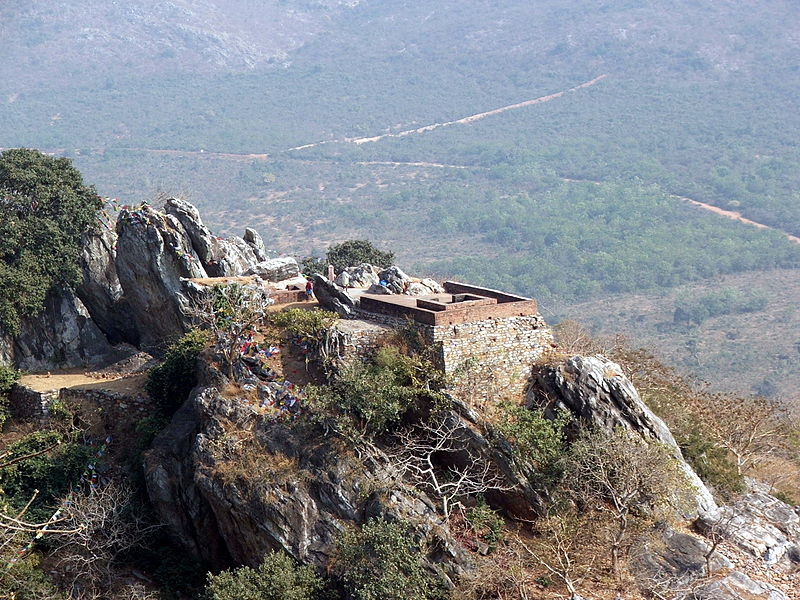
Vulture Peak (Bihar, India)
Devadatta then incited five hundred new disciples to follow him and secretly moved them to Mount Gayasisa (Elephant Head Mountain), where he lived. To disrupt the Buddha’s teachings is the grave sin of “schism” (sanghabheda), and it is said that many beings throughout heaven and earth mourned this act. Following this, Devadatta reportedly taught his own versions of the “Noble Eightfold Path” at Mount Gayasisa.
Sariputra thought, “I must bring these five hundred new disciples back,” and went to Devadatta’s abode. While Devadatta was fast asleep, Sariputra approached the group, and Maudgalyayana placed the five hundred disciples into his alms bowl and bag, flying through the air to return them to the Buddha.
Devadatta’s disciple, Kokalika, was furious and struck his master’s face with a shoe. Devadatta woke up and was consumed with rage, crying, “The five hundred disciples have been taken back!”
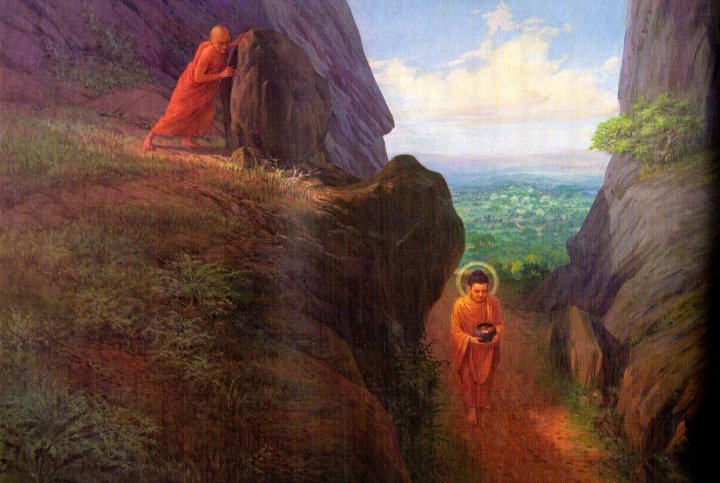
Devadatta then attempted to hurl a massive rock at the Buddha. Although a mountain deity blocked the rock and prevented a direct hit, a splinter struck the Buddha’s foot, causing his toe to bleed. This became his second grave sin. Devadatta then coated his fingers with poison, pretending to massage the Buddha’s injured foot to poison him. However, it is said that the poison instantly turned into medicine, and the wound was healed.
Furthermore, King Ajatashatru (the ruler of the Magadha Kingdom in Northern India) followed Devadatta’s deceptive advice. They plotted to kill the Buddha by forcing a large elephant to drink wine and releasing the drunken beast toward him. When the five hundred Arhats (the Buddha’s disciples) saw the drunken elephant, they were so terrified that they flew into the sky. However, the Buddha manifested the heads of five lions from his hand, causing the drunken elephant to flee in terror.
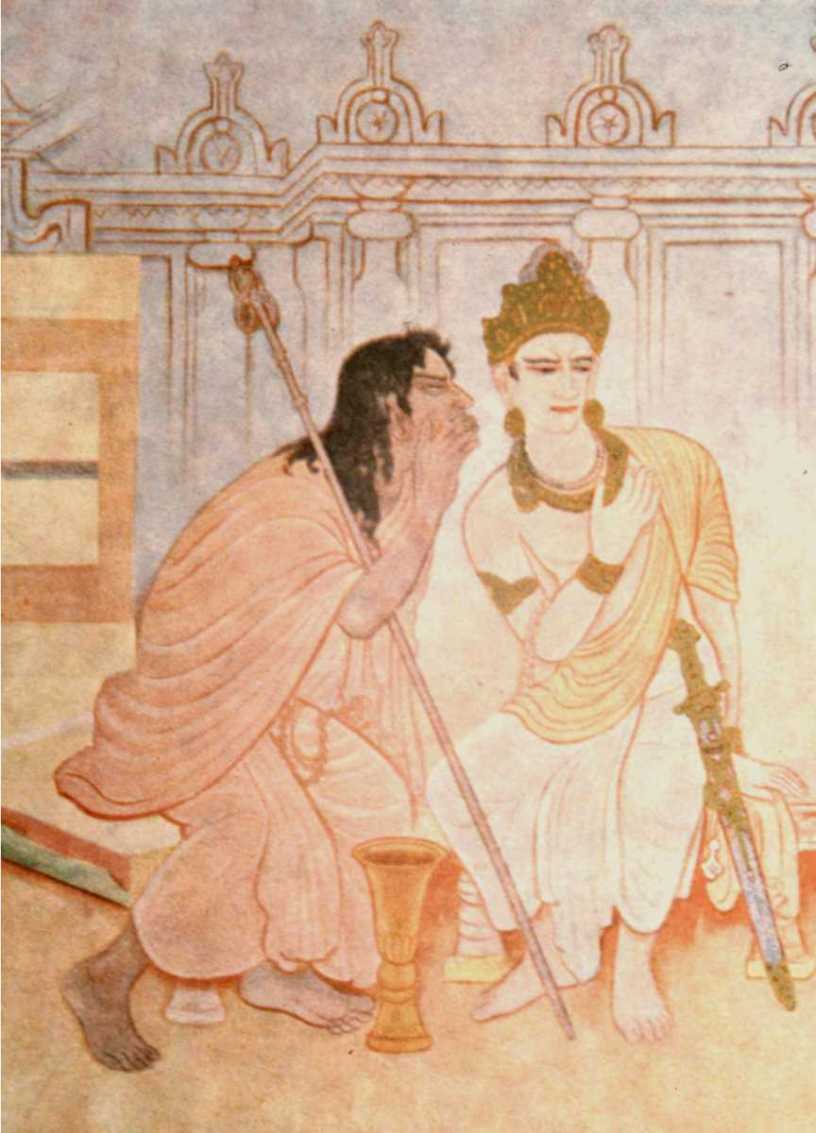
Devadatta instigating King Ajatashatru
The Buddha then entered King Ajatashatru’s palace, where he preached and converted the King, who became a devoted follower. Increasing in malice, Devadatta left the palace.
Later, Devadatta struck the head of the nun Utpalavarna (Lotus-colored). The Arhat nun lost her life. This became his third grave sin.
Finally, the earth split open, and Devadatta fell into hell. It is said that the fissure in the earth remains to this day.
[Translation]
Shinichi Kusano / Siro Inuzuka
This text was created by using Gemini to translate a modern Japanese translation into English, and then making some modifications. There may be errors in the English expressions. Please correct any mistakes.
[Explanation]
Shinichi Kusano / Siro Inuzuka
The Rivalry: Devadatta is known as the “Enemy of the Buddha.” As the Buddha’s cousin, he was constantly compared to him before their renunciation. It is said his jealousy grew because he could never surpass Siddhartha in any endeavor.
Literary Representation: In his novel Devadatta, Kansuke Naka depicts Devadatta’s complex feelings – a mix of respect and hatred. He portrays Devadatta as being passionately in love with Princess Yasodhara, only to lose her to the Buddha, thus suffering defeat in both spiritual and romantic life.
Historical Sect: Although not mentioned in this specific tale, Devadatta was once a disciple of the Buddha. He grew dissatisfied with what he perceived as a lax management of the early Buddhist community and broke away to form a sect with much stricter precepts.
Persistence of the Sect: This sect survived for a surprisingly long time. The Tang Dynasty monk Xuanzang recorded in his Great Tang Records on the Western Regions that he encountered a community of Devadatta’s followers in Northern India during his 7th-century travels.
King Ajatashatru: His story is found in the Amitayurdhyana Sutra. The tale of how he murdered his father to become King of Magadha is considered both dramatic and erotic.
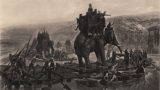
War Elephants: Using drunken elephants as weapons was an ancient Indian practice. The “Elephant Corps” was a central element of military strategy. It is said that Alexander the Great, after conquering Greece, Persia, and Centra Asia, had to withdraw partly because he had no effective countermeasure against these elephant units. By the time Hannibal crossed the Alps in the 2nd century BCE, the use of elephants in war had become more widespread, and they were even being exported.
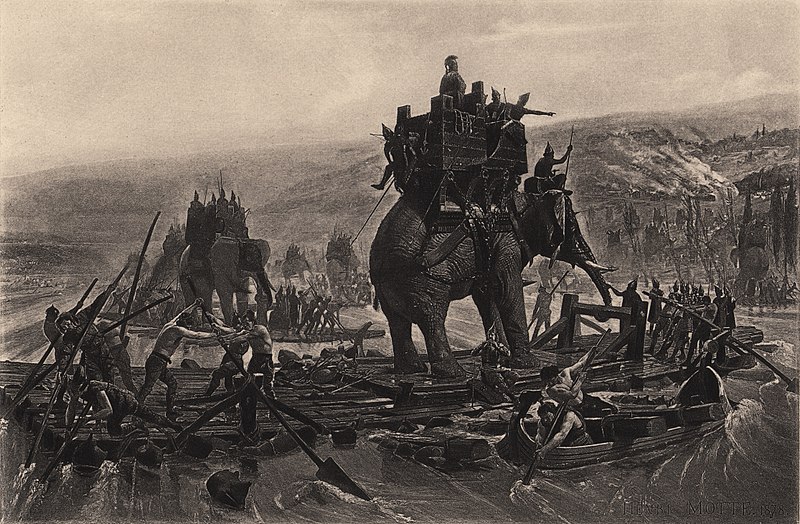
War elephants crossing the Rhône with Hannibal. Painted by Henri-Paul Motte, 1878
The Lotus Sutra: The “Devadatta Chapter” of the Lotus Sutra teaches that even Devadatta, the enemy of the Buddha, can attain enlightenment. This represents the concept of Akunin Shoki – the idea that even the most evil people can be saved.
●Japanese



コメント