Once upon a time, during the reign of Emperor Yuan of the Han Dynasty in China (49 BC – 33 BC), the Emperor selected the daughters of his ministers and high officials who were exceptionally beautiful and possessed an indescribable elegance. He kept them within the palace and bestowed his favor upon them. However, as their numbers grew to over five hundred, it became impossible for every woman in the palace to receive the Emperor’s personal attention.
One day, people from the remote barbarian kingdom of Hu arrived at the capital. They appeared uncouth, like people from an uncivilized land. The Emperor, his ministers, and all the officials were troubled by how to treat these visitors and held many discussions, but they could not come up with a good plan.
Eventually, a wise minister stepped forward with a clever suggestion: “It is not good for the country to have such barbarians coming to the capital. We must find a way to make them return to their own land. Therefore, it would be best to choose one of the less attractive women among the many in the palace and give her to them. If we do so, they will surely be delighted and return home. There is no better plan than this.”
The Emperor thought this was a reasonable idea. He intended to judge the women himself, but because there were so many, he found it an impossible task. Thus, he came up with another plan: “I shall summon many court painters, have them see these women and paint their likenesses. I will look at the paintings and bestow the one who appears least attractive upon the people of Hu.”
He immediately summoned the painters and ordered them to meet the women and bring back their portraits. When the painters began their work, the women, terrified that they might be taken away to a far-off, primitive land, wept and vied with one another to give the painters gold, silver, and various treasures. Dazzled by these bribes, the painters began to depict even the less attractive women as beautiful.
Among these women was one named Wang Zhaojun. She was far more beautiful than any of the others. Relying on her natural beauty, she did not give anything to the painters. In retaliation, the painter did not depict her as she truly was, but instead painted her with a very lowly and plain appearance. As a result, it was decided that she should be the one given away.
However, feeling suspicious, the Emperor summoned her before him. When Wang Zhaojun appeared, she was so radiant that she seemed to emit light, possessing a truly graceful and exquisite beauty. She was like a shining jewel. Compared to her, the other women seemed like mere lumps of clay.
The Emperor was shocked and deeply grieved that such a woman had to be given to the barbarians of Hu. But days had passed, and the people of Hu had already heard rumors that they were to receive Wang Zhaojun. They came to the palace and persistently demanded her. Unable to change the decision and choose another woman at that late stage, the Emperor finally gave Wang Zhaojun to them. The people of Hu placed her on a horse and began the journey back to their land.
Wang Zhaojun wept in sorrow, but it was in vain. The Emperor, too, longed for her and felt such deep sadness that he visited the place where she had once lived. There, the spring willows swayed in the breeze, and warblers sang from time to time; in autumn, fallen leaves piled up in the courtyard, and the loneliness of the empty eaves was beyond words. This only deepened his longing and grief for her.
The people of Hu were overjoyed to have received Wang Zhaojun. They played the pipa and other instruments as they escorted her. Although Wang Zhaojun continued to weep, she felt a small measure of comfort in the sound of the music.
Upon arriving in the land of Hu, she was treated with the utmost respect as a queen, but her heart never truly cleared of its sorrow.
It is passed down that the people of that time criticized her, saying, “This happened because she relied too much on her own beauty and failed to give gifts to the painters.”
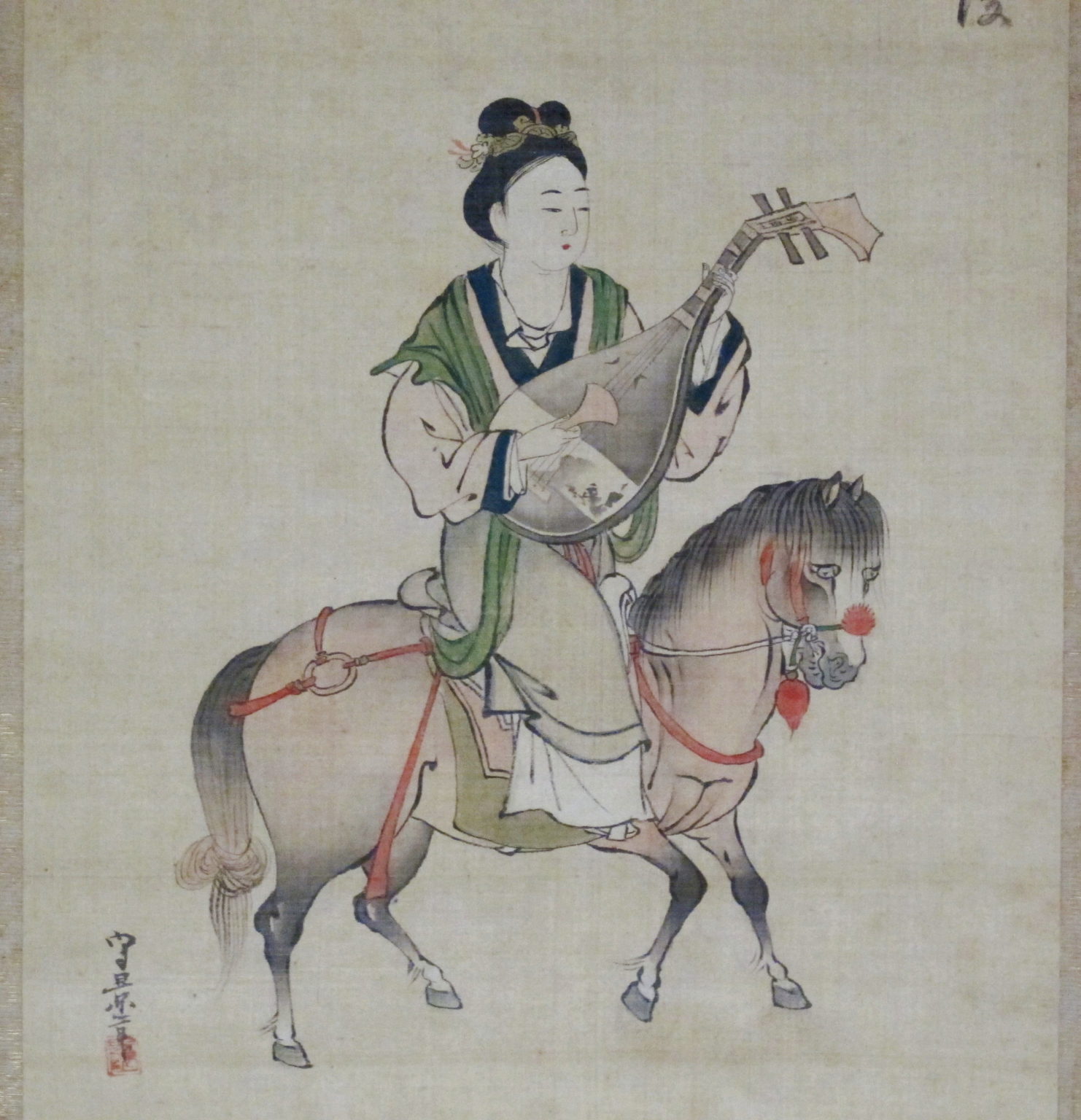
Wang Zhaojun (by Kusumi Morikage, Japan 17th century)
[Translation]
Kaori Sekijitsu / Siro Inuzuka
This text was created by using Gemini to translate a modern Japanese translation into English, and then making some modifications. There may be errors in the English expressions. Please correct any mistakes.
[Explanation]
Shinichi Kusano / Siro Inuzuka
“Hu” (胡) is a collective term for northern nomadic peoples, such as the Xiongnu and the Xianbei. While this story describes them as “uncivilized” or “barbaric” (i / 夷), this reflects the discriminatory perspective held by the Han Dynasty. In reality, the Xiongnu were a vital diplomatic partner for the Han, making it highly unlikely that the Han would have actually sent them an “ugly woman” as a gift.
Later, after the fall of the Han Dynasty and during the era of the Sixteen Kingdoms, the Chinese mainland was divided and ruled by numerous small states. The “Hu” peoples occupied a significant portion of these states and frequently employed Han people in their service. It is thought that this story may have been a fictional creation by Han people who served the Hu.
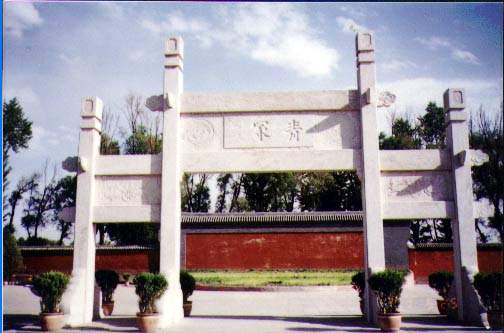
The Tomb of Wang Zhaojun (Inner Mongolia Autonomous Region)
●Japanese



コメント