
Once upon a time, in the Yokawa area of Mount Hiei, there was a monk. He had awakened his religious heart and devoted himself solely to chanting the Nembutsu of Amida Buddha, praying, “Please let me be reborn in the Pure Land (Paradise).” He was well-versed in Buddhist teachings, but he desired only to be reborn in the Pure Land and had no other wishes. For this reason, other holy men also thought, “This person will surely be reborn in the Pure Land.”
Eventually, years passed, and the holy man reached over seventy years of age. Although he was originally of a robust constitution, he would often catch colds and sometimes could not eat as he wished. He gradually grew weaker, and one day he finally said, “It seems my time of death is near.” His religious devotion became even deeper, and there was no slackening in the voice with which he chanted the Nembutsu.
His illness grew grave, and finally, he could no longer get up. While lying down, he chanted the Nembutsu incessantly. He also said to his disciples, “Now I only want to hear the Nembutsu. Do not let me hear other things.” The disciples murmured that this was a noble thing and encouraged the Nembutsu.
Around the tenth day of September, around the Hour of the Monkey (4:00 PM), his consciousness seemed to be weakening. An image of Amida Buddha was placed at his pillow, five-colored threads were attached to the Buddha’s hand, and while pulling them, he chanted the Nembutsu about forty or fifty times and passed away as if falling asleep. The disciples said with reverence and joy, “The holy man has fulfilled his long-standing wish and must have gone to the Pure Land.” After finishing all the post-death matters and the forty-nine days had passed, the disciples each departed.
One disciple inherited the master’s quarters and was living there. One day, the disciple found a small unglazed jar that the master had used to keep vinegar on a shelf in the storage room. “Was the holy man’s vinegar jar here? I thought it had been lost,” he thought. When he took it out and tried to wash it, there was something moving inside the jar. When he looked inside, a small snake of about five inches was coiled up. He thought it was frightening and placed it on top of some firewood.
That night, the deceased holy man appeared in the monk’s dream and told him:
“I, as you saw, have devoted myself solely to wishing for the Pure Land and chanting the Nembutsu. When my life was ending, I thought, ‘I shall pass away with no other thoughts, only chanting the Nembutsu.’ However, at that moment, I happened to see the vinegar jar on the shelf. And I thought, ‘When I am gone, whose will this become?’ While my mouth chanted the Nembutsu many, many times, only once did I think so in my heart. Without thinking of it as a sin or thinking I was doing something wrong, I passed away. Because of that sin, I have received the body of a small snake inside this jar. Quickly offer this jar as a fee to recite sutras for me. For my sake, perform a Buddhist service with great care. By doing so, I will be able to be reborn in the Pure Land.”
When he said this and vanished, the disciple woke up.
“Then, the small snake in this small jar is the form of the deceased holy man.”
The next morning, just as the dream had foretold, he had the small jar offered at the Chudo hall and had sutras recited. It was a very sad feeling. Furthermore, he performed a Buddhist service with great care.
Even a holy man who died so nobly received the body of a small snake because he saw a trivial thing at the very end. How much more difficult must it be for people who die surrounded by their wives and children to attain birth in the Pure Land, even if they have awakened their faith, if they are tied to those connections? It is a sad thing.
“When life ends, one should hide trivial things and make sure nothing other than the Buddha enters one’s sight.”
It is said that Bishop Genshin of Yokawa spoke these words.
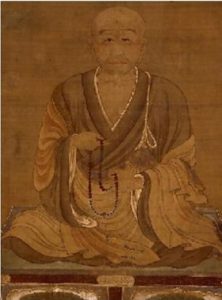
Genshin
[Translation]
Shinichi Kusano / Siro Inuzuka
This text was created by using Gemini to translate a modern Japanese translation into English, and then making some modifications. There may be errors in the English expressions. Please correct any mistakes.
[Explanation]
Shinichi Kusano / Siro Inuzuka
It is called a vinegar jar, but it does not say the contents were vinegar. In this era, everyone would have known that putting salt in sake makes vinegar. The term “vinegar jar” is used on the premise of that knowledge.
●Japanese




コメント