

Once upon a time, in India, there was a bhikkhuni (a Buddhist nun) who had attained the state of an arhat(a saint). Her name was Mimyo.
Addressing many nuns, she spoke about the good and evil karma she had created in her previous lives.t
“In a past age there was a wealthy householder. His household was large and prosperous, and he possessed abundant treasures. However, he had no children. He took a concubine and loved her deeply. She gave birth to a boy.
The couple – the master and the concubine – both loved the child and felt no aversion toward him.
But the lawful wife became jealous.
She thought:
‘If this child grows up and becomes an adult, he will inherit the household. I will become useless. Even if I diligently manage the household, it will mean nothing. I should kill this child.’
Secretly taking an iron needle, she waited for an opportunity and stabbed the child in the head. The child died.
The mother grieved deeply.
“It must have been the lawful wife who killed him out of jealousy.”
She said to the wife,
“You killed my child, didn’t you?”
The wife replied,
“I did not kill your child. I will swear an oath and make the truth clear. If I did kill your child, then even after I am reborn, may my husband die from the bite of a snake, and may my child drift in the water and become food for wolves.”
After making this oath, the lawful wife died.
Because she had killed the child, she fell into hell and suffered immeasurable torment. After the retribution of hell had been exhausted, she was reborn as the daughter of a brahmin. When she grew up, she married and gave birth to one child.
Later she conceived again. When the time of birth came, she went with her husband to her parents’ home. Because her husband was poor, they had no attendants. On the way, her labor pains began and she gave birth. That night they stayed beneath a tree. Her husband slept nearby.
During the night, a poisonous snake appeared and bit the husband, killing him. When the wife saw that her husband had died, she collapsed in agony and also died.
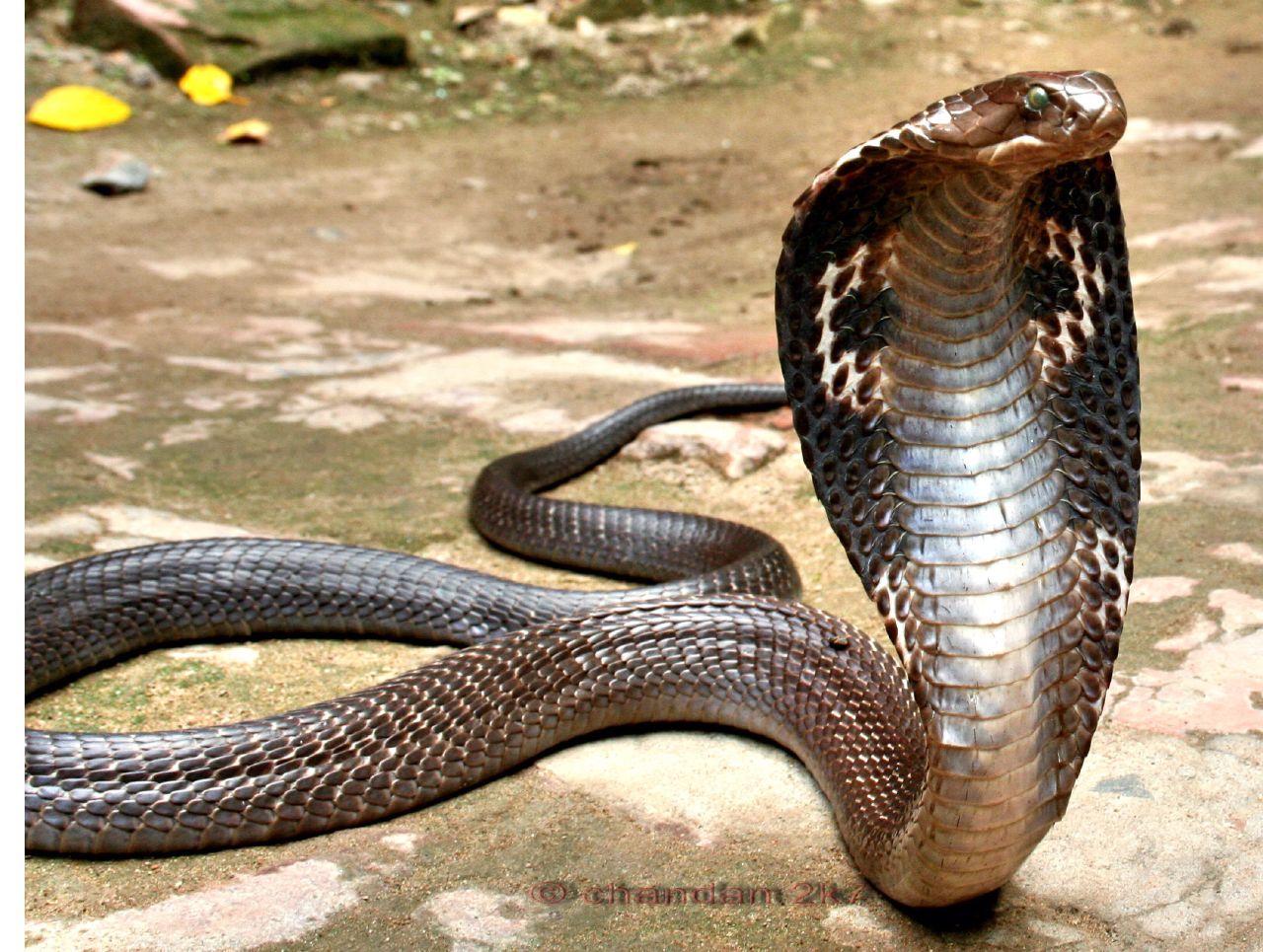
A large Indian cobra
After a while she revived.
When morning came, she could not remain there alone. Carrying the newborn baby in her arms and the older child on her back, she walked on weeping, intending to go to her parents’ house.
On the way she came to a river. It was very deep and wide. She placed the older child on this bank and first carried the newborn across. After reaching the far bank, she set the baby down and returned to fetch the older child.
The child, seeing his mother crossing the river toward him, entered the water. The mother, seeing this, was alarmed and hurried to catch him, but the child was swept away by the current. She could not save him. He drowned.
Weeping, the mother crossed back to the opposite bank. But the baby she had left there was gone. Only traces of blood remained. A wolf was nearby – the wolf had devoured the child.

Seeing this, the mother collapsed and died.
After some time she came back to life again and began to walk. On the way she met a brahmin who was a close friend of her father. The woman told him in detail how she had lost her husband and children. Hearing this, the brahmin pitied her deeply.
She asked him,
“Are my parents safe?”
He replied,
“Yesterday your parents’ house caught fire. Your father and mother, as well as all the members of the household, both high and low, were burned to death.”
Hearing this, the woman cried out in grief and fainted again. The brahmin took pity on her, brought her to his home, and cared for her.
Later the woman married another man and again became pregnant. When the time for childbirth approached, her husband went out drinking. Drunk, he returned after nightfall. Because it was dark, the wife had shut the gate. The husband stood before it and knocked, but at that moment she was trying to give birth by herself. No one opened the gate, and in the end she gave birth alone.
The husband broke down the gate and entered, beating his wife. Although she told him about the childbirth, his anger did not subside. He boiled the child in milk and forced the wife to eat it.
The wife thought:
“Because my fortune is thin, I have encountered such a husband. I will flee.”
She abandoned him and ran away.
She entered the kingdom of Varanasi and rested beneath a tree. In that country there was a wealthy man who had lost his wife and lived in sorrow, rarely leaving his house. When he saw the woman sitting alone under the tree, he asked about her circumstances. He then took her as his wife.

Varanasi,India
After only a few days, that husband suddenly died. According to the custom of that country, when a beloved husband died, his wife was buried alive with him. A band of thieves gathered to bury her. But their leader, seeing that the woman was very beautiful, decided to marry her himself and made her his wife.
A few days later, the thief entered a house to rob it. The owner of the house killed him. One of the thieves brought the corpse and showed it to the woman. According to the custom of the land, she was buried alive together with her husband. After three days, foxes and wolves dug up the grave, and the woman was able to come out.
She lamented:
“What sin have I committed that I suffer such heavy misfortune for so long, dying and yet coming back to life again and again? Where should I go?”
Then she thought:
“I hear that the Shakyamuni Buddha is at the Jetavana Monastery. If I still have life left, I will go there.”
She went there and asked to become a nun.
Because in a previous life she had once offered food to a Pratyekabuddha and had made a vow, she was now able to encounter the Buddha, renounce the world, practice the path, and attain the state of an arhat. However, because of the sin of killing in her former life, she again fell into hell. Even now she continues to receive evil retribution because of the false oath she swore.
Mimyo herself said:
“That woman who became the wife in those lives is none other than my present self. Although I have attained the fruit of arhatship, a red-hot iron needle constantly enters through the top of my head and comes out through the soles of my feet. Day and night this unbearable suffering never ceases.”
Thus it is said that the results of good and evil deeds are like this and never disappear.
[Translation]
Shinichi Kusano / Siro Inuzuka
This text was created by using chatGPT and Gemini to translate a modern Japanese translation into English, and then making some modifications. There may be errors in the English expressions. Please correct any mistakes.
[Explanation]
Shinichi Kusano / Siro Inuzuka
This is a cruel story. The child drowns, another becomes food for wolves, and the mother is even forced to eat her own child. Despite such misfortunes, she is not allowed to die peacefully. She revives again and again, and the nightmare continues.
[Cooperation]
Shinichi Kusano
●Japanese



コメント