
Once upon a time, there was a man known as General Toshihito. He served under the most powerful man of that era (Fujiwara no Mototsune). Because he had entered the house of Arihito – a man of both influence and virtue in the province of Echizen as a son-in-law, he went to live in that province after his marriage.
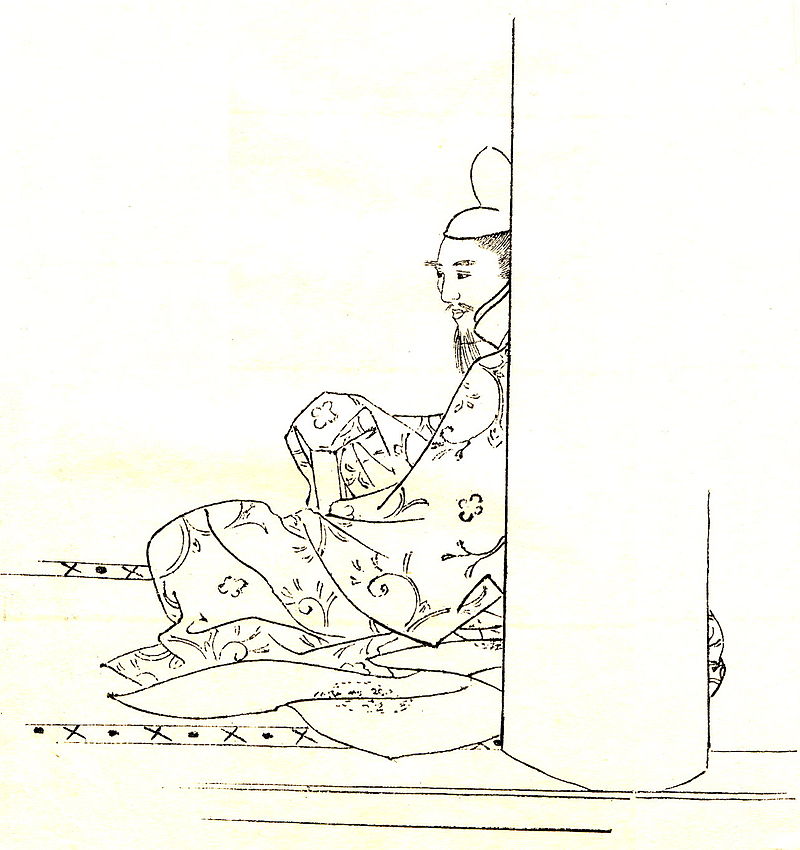
Fujiwara no Mototsune (from Kikuchi Yosai’s “Zenken Kojitsu”)
One year, a New Year’s celebration was held at his master Mototsune’s mansion. In modern times, after the Great Banquet concludes, it is common to hold a “Toribami” (leftover feast) where food is distributed to the lower servants and those who work in the mansion. However, in those days, the Great Banquet was held only for the samurai.
Among them was a samurai of the Fifth Rank (Goi). He had served the Regent’s house for a long time. (Fifth Rank is a lower class of official; one must be Fourth Rank or higher to be allowed into the Courtiers’ Hall). It happened while the samurai were eating and drinking during the banquet. The Fifth Rank samurai slurped his Yam Gruel (a high-class delicacy of the time), smacked his lips, and said: “Ah, I wish I could eat this yam gruel until I was sick of it.”
Hearing this, Toshihito asked: “Master, have you never eaten enough to be satisfied?” The Fifth Rank samurai replied: “No, I never have.” Toshihito said: “In that case, let us see to it that you eat until you are sick of it.” The Fifth Rank samurai replied: “That would be a truly happy thing.”
The Fifth Rank samurai lived in a room granted to him within the Regent’s (Mototsune’s) compound. Four or five days later, Toshihito came to that room and said: “Master, please come with me. There is a fine hot spring in Higashiyama.” The Fifth Rank samurai answered: “That sounds wonderful. My body has been itchy lately, and I haven’t been able to sleep well. However, I do not possess a mount.” Toshihito said: “I will prepare a horse for you.” The Fifth Rank samurai was overjoyed. He wore two layers of thin cotton robes, donned a pair of bluish-grey sashinuki trousers with torn hems, and wore a kariginu hunting robe of the same color that drooped slightly at the shoulders. He wore no under-trousers beneath. He was a man with a high nose, but the tip was red and the nostrils were slightly moist, likely because he did not wipe his nose. The back of his hunting robe was pulled askew by his sash, but he made no attempt to fix it, presenting quite a ridiculous appearance.
With the Fifth Rank samurai in the lead, the horses headed out toward the Kamo riverbank. The Fifth Rank samurai did not have a single child attendant with him. Toshihito, too, was accompanied only by one chodo (weapon bearer) and one toneri (groom).
Before long, the horses passed the riverbank and reached Awataguchi. When the Fifth Rank samurai asked, “Where is it?” Toshihito replied, “Just a little further.” By the time they passed Yamashina, the Fifth Rank samurai said: “You said it was close, yet we have already passed Yamashina.” Toshihito said: “It is just soon.” Passing Sekiyama, they arrived at a monk’s quarters at Mii-dera Temple (in Otsu City, Shiga Prefecture), where Toshihito had an acquaintance.
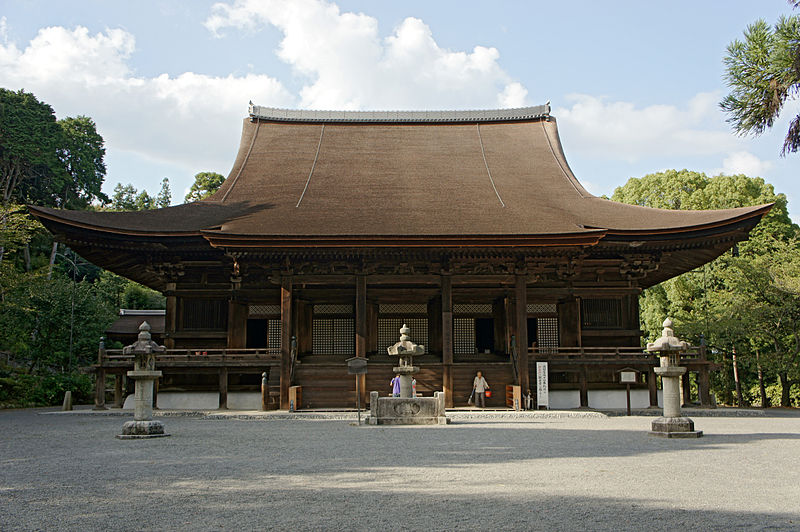
Mii-dera Temple (Otsu City, Shiga Prefecture)
The Fifth Rank samurai thought: “Is the hot spring here? It was outrageously far.” A monk greeted them, saying, “You are most welcome,” and offered hospitality. However, there did not appear to be any hot spring. The Fifth Rank samurai asked: “Where is the hot spring?” Toshihito answered: “Actually, I intend to take you to Tsuruga (Tsuruga City, Fukui Prefecture, facing the Sea of Japan).” The Fifth Rank samurai said: “You say the most outrageous things! If I had known this in Kyoto, I would have brought servants. I have brought no attendants at all. How do you propose we go to such a distant place? This is a terrifying situation.” Laughing, Toshihito said: “With me alone, it is the same as having a thousand men.” And indeed, it was exactly so.
After eating, they departed. Toshihito now carried a koroku (a quiver for arrows) on his back.
When they reached the shores of Mitsu, a fox appeared. Upon seeing it, Toshihito said, “A perfect messenger has appeared.” Toshihito charged at it. The fox managed to flee, but it was chased down and could not escape. Toshihito slipped under the belly of his horse, grabbed the fox by its hind legs, and lifted it up.
Toshihito’s horse did not look like a particularly fine steed, yet it was incredibly fast. It did not let the fox escape at all. Dangling the captured fox, Toshihito said: “Fox, go to Toshihito’s house in Tsuruga tonight and tell the household: ‘He is suddenly returning with a guest. Bring two saddled horses to the vicinity of Takashima by the Hour of the Snake (10:00 AM) tomorrow.’ If you can get away without delivering this message, then try it. You foxes have mastered the art of transformation, have you not? You must go and deliver this message within today.” Watching this, the Fifth Rank samurai said: “That is quite a messenger you have there.” Toshihito replied: “Just watch. It cannot help but go.” The fox ran off, looking back at them many times as it went.

They stayed the night on the road. The next morning, they departed early. Around the Hour of the Snake (10:00 AM), a group was approaching about 20 or 30 cho (2-3km) ahead. As they watched, wondering who it was, Toshihito said: “Yesterday’s fox must have delivered the message. My retainers have come to welcome us.” While the Fifth Rank samurai was saying “Surely not,” the group approached and scrambled off their horses. “See? They came.” Smiling, Toshihito asked them: “Well? Are the horses ready?” “We have two head.” The retainers had also brought food, so they sat down in the area to eat. At that time, the retainers said: “Last night, a strange thing happened.” “What was it?” Toshihito asked. “Last night, at the Hour of the Dog (around 8:00 PM), the Mistress suddenly felt a pain in her chest. We wondered what was wrong, and she spoke like this: ‘I am a fox. Today at noon, at the beach of Mitsu, I met the Master as he was coming down from Kyoto. I tried to run, but I could not, and I was captured.’ ‘Then, the Master said to me: “Tell the retainers: I am suddenly returning with a guest. Bring two saddled horses to meet us around Takashima by the Hour of the Snake tomorrow. If you do not deliver this message within today, I will suffer greatly.”‘ ‘Retainers, please depart immediately. If you are late, I will be made to suffer a painful experience.’ The Mistress made such a fuss saying this. The Great Lord (Toshihito’s father) said, ‘That is an easy task,’ and summoned the retainers. Upon doing so, the Mistress recovered instantly. After that, we departed at the first crow of the rooster.”
Hearing this, Toshihito smiled and exchanged a glance with the Fifth Rank samurai. The Fifth Rank samurai could only be amazed.
They arrived at Toshihito’s house around dusk. “See that? It was true (what the fox said), wasn’t it?” The household was in an uproar. The Fifth Rank samurai dismounted and looked at the house. It was incomparably wealthy. He put on Toshihito’s nightclothes over the two robes he had worn from the start, but since he was still terribly cold, he had a long brazier brought in with fire and had many tatami mats laid out. The sweets and food arranged for him were incredibly luxurious. Saying, “You must have been cold on the journey,” they had him wear three layers of thick, padded clothes in a glossy silk color (neri-iro). He felt a very blissful sensation.
Late at night, the father-in-law, Arihito, came to see Toshihito and the Fifth Rank samurai and asked: “Why have you come down from Kyoto so suddenly? Furthermore, a very strange messenger arrived. My wife suddenly fell ill. I was worried.” Toshihito smiled. “I thought I would test if it could serve as a messenger, so I ordered it to do so. It seems it actually came and delivered the message.” The father-in-law laughed as well. “Indeed, such a thing is rare. By the way, the messenger mentioned you had someone with you. Is it this gentleman here?” “Yes. He said he wished to ‘eat yam gruel until he was sick of it,’ so I said ‘I shall let you do so,’ and brought him along.” The father-in-law said: “Well now, he has desired something quite simple.” The Fifth Rank samurai said: “He tricked me into coming by saying ‘There is a place where hot water springs forth in Higashiyama.'” As they talked, the night deepened, and the father-in-law returned to his quarters.
When the Fifth Rank samurai went into the sleeping quarters to rest, a cotton hitatare (samurai ceremonial robe) about four or five sun (approx. 15 cm thick padding) was prepared for him. Since the thin cotton he was originally wearing was uncomfortable and itchy in places, he threw it all off. Wearing this hitatare over three layers of glossy silk robes, the feeling when he lay down was unlike anything he had ever experienced. Because of this, he sweated profusely, but he realized there was someone else nearby. “Who is it?” he asked. A woman’s voice replied: “I was ordered to rub your feet, so I have come.” She was very cute, so he pulled her close, and they rested together where the breeze came in.
He heard a shouting voice saying: “Listen well, servants! Tomorrow morning at the Hour of the Rabbit (around 6:00 AM), each of you is to bring one mountain yam, with a cross-section of three sun (approx. 9cm) and a length of five shaku (approx. 150cm).” “What a strange thing to say,” he thought, and fell asleep.
Around dawn, there was the sound of straw mats being laid in the garden. Wondering what was happening, he lifted the shitomi (latticed shutters) after daybreak to look. Four or five long mats were spread out. Wondering what they would be used for, he saw things that looked like logs being placed on them. As he watched them being placed one after another, he realized they were actually yams with cross-sections of three or four sun and lengths of five or six shaku. By the Hour of the Snake (10:00 AM), they were piled as high as the eaves. The shouting voice he heard last night had stood atop a famous burial mound called “Hitoyobi-no-Take” (Hill of Calling Men) and commanded the neighboring servants. This immense amount was brought only by the servants who heard that voice. If those living further away were included, who knows what the number would be? It would be a number beyond imagination.
Thinking, “This is outrageous,” he watched as they brought five or six cauldrons with a capacity of five koku (approx. 900 liters), drove stakes into the ground, and set the cauldrons up. Wondering “What are they doing?” he saw young maidservants, wearing white cloth robes called ao tied with sashes, bringing fresh white buckets filled with water. “They are putting water in the cauldrons. Are they boiling water?” What looked like water was actually Misen (a sweet syrup made from decocted ivy sap, very precious). Furthermore, more than ten young men took long, thin knives from their sleeves and began peeling the yams and slicing them directly into the pots. “Ah, they are making yam gruel.” The moment he thought this, he lost the desire to eat. He felt completely fed up.
Eventually, a voice announced, “The yam gruel is ready.” When he had them bring it, they poured three or four scoops into a large clay vessel – big enough to hold a silver hisage (sake vessel) of one to (approx. 18 liters) – and brought it to him. He did not feel like touching his chopsticks to it at all. When he said, “I am already full,” everyone burst into laughter. They said things like, “Thanks to our guest, everyone can eat yam gruel.”
At that moment, Toshihito spotted a fox on the eaves of the house across the way. “Look. Yesterday’s fox has come.” He further ordered: “Feed the yam gruel to that one.” The fox ate its fill and then left.

The Fifth Rank samurai stayed for about a month, and everything was nothing but enjoyable.
He was given many keosame outfits to wear when attending court. Additionally, textiles of twill, silk, and cotton were placed in wicker trunks and handed to him. Of course, he was given those nightclothes as well. Since these were loaded onto saddled horses and even oxen for transport, when he returned to Kyoto, the Fifth Rank samurai was extremely wealthy.
It is handed down that for those who have served for many years and are regarded with some respect by others, things like this naturally happen.
[Translation]
Siro Inuzuka
This text was created by using Gemini to translate a modern Japanese translation into English, and then making some modifications. There may be errors in the English expressions. Please correct any mistakes.
[Explanation]
Shinichi Kusano / Siro Inuzuka
This is the story that served as the basis for Ryunosuke Akutagawa‘s novel Yam Gruel (Imo-gayu).

Akutagawa in 1927
In Yam Gruel, Akutagawa focuses on the man referred to here only by his rank, “Fifth Rank” (Goi), casting him as “a man so disregarded his name is not even recorded.” This choice of protagonist was a massive success.
However, reading the original story reveals that the Fifth Rank samurai’s name is not omitted because he is disregarded. The protagonist of this tale is Toshihito, and the lack of a name is intended to keep the focus on him.
Conversely, Akutagawa’s insight in taking this Fifth Rank samurai and making him the protagonist is remarkable.
Furthermore: This is actually a story about a lucky guy who gets treated to delicious food and a fine woman. Akutagawa depicted the Fifth Rank samurai as a shabby, incompetent man, but in the original story, that is not the case at all. In other words, we have been fooled by Akutagawa for over 100 years.
(Note: The wife speaking the fox’s words is what is known as kitsunetsuki, or fox possession.)
[Cooperation]
Shinichi Kusano
●Japanese




コメント