Once upon a time, there lived two brothers in a district [blank] of a country [blank]. Both were men of courageous spirit and possessed sound judgment and deliberation.
In the meantime, their father passed away. They placed his body in a coffin, closed the lid, and set it in a distant side room. As the day of the funeral was still far off, several days passed. The brothers heard unreliable eyewitness accounts: “When the body is laid out in that room, it strangely starts to emit light late at night.”
The brothers discussed this, saying, “Could it be that the dead man has turned into a mononoke (spirit/monster) and is glowing? Or is some mononoke visiting the corpse? Let us discover its true identity.”
The younger brother made a promise to the elder, “When you hear my shout, light a fire and be sure to come immediately.”
When night fell, the younger brother secretly approached the coffin room. He flipped the coffin lid over and, completely naked with his hair disheveled, lay down on top of it, face up. He tightly concealed a sword against his body so it was not visible from the outside.
He waited until he thought it was deep midnight. He slowly opened his eyes slightly and saw that the ceiling seemed to be glowing.
After the light flashed about twice, something opened the ceiling panel and climbed down. Since the brother was not fully opening his eyes, he couldn’t clearly make out what it was, but he heard a loud thud as it landed on the wooden floor. It was a large creature glowing bright blue.
Waiting for the moment it would try to remove the coffin lid and place it aside, the younger brother suddenly embraced the creature tightly, shouted loudly, “I’ve got you! Ho!” and drove his sword up to the hilt into what he presumed to be its flank.
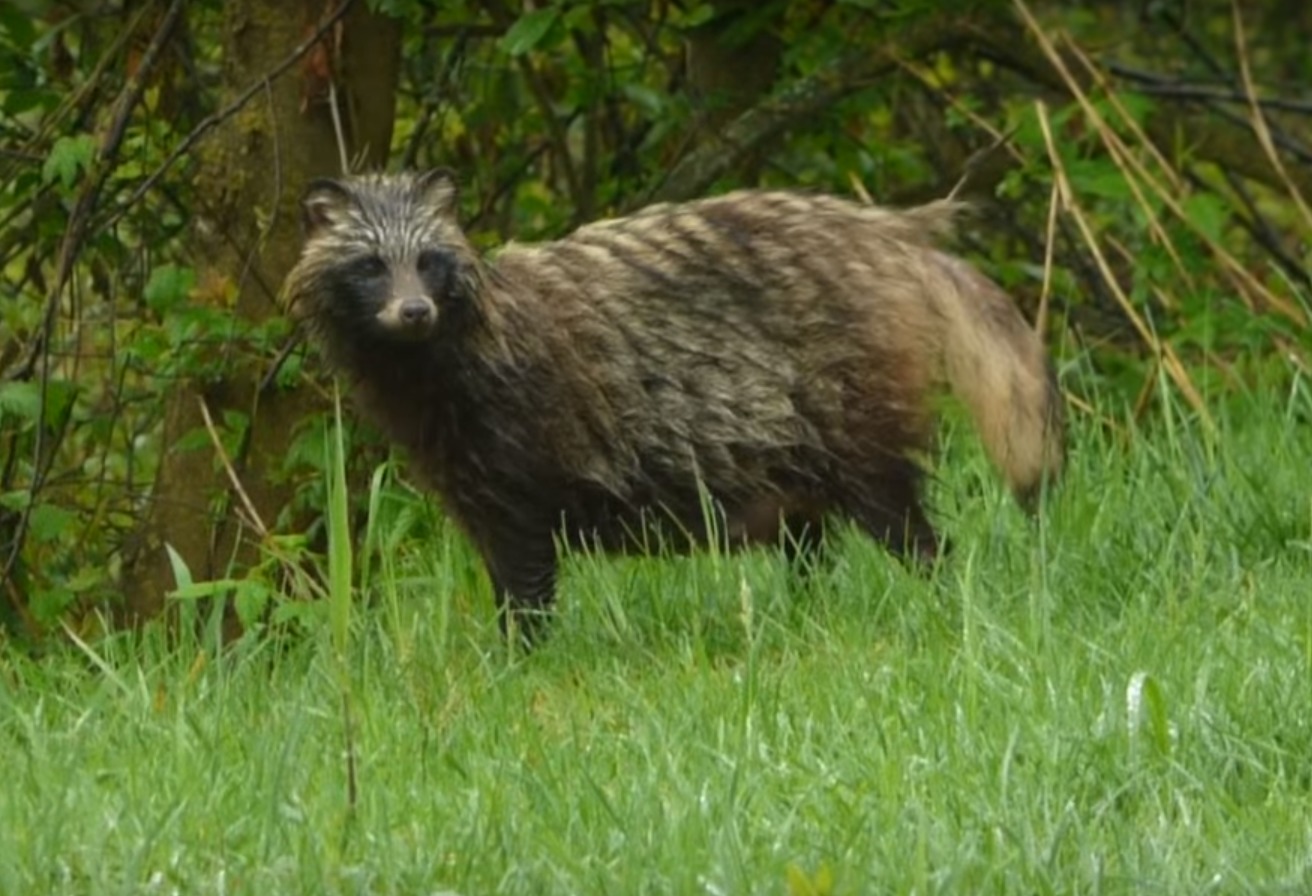
At that moment, the light vanished. The elder brother, who had been anxiously waiting for this signal, immediately lit a fire and rushed to the room. When he held the light up to what his brother was embracing, he saw he was clinging to a large, hairless wild boar (a type of raccoon dog/badger). The wild boar was dead, stabbed in the flank by the sword. The brothers were utterly astonished and amazed.
It must have been deeply unsettling for the younger brother to lie in the coffin. To lie there in such a state, knowing that a demon is always near a corpse, takes extraordinary courage. He was not worried because he believed it was a wild boar, but until he figured that out, he must have assumed it was a demon. The elder brother lit a fire and rushed over – but anyone would rush over just as quickly.
Furthermore, it is told that the wild boar lost its life for no reason.
[Translation]
Kenta Hasegawa / Siro Inuzuka
This text was created by using Gemini to translate a modern Japanese translation into English, and then making some modifications. There may be errors in the English expressions. Please correct any mistakes.
[Explanation]
Kenta Hasegawa
Mononoke (物の気): A spirit, ghost, or monstrous apparition.
Hairless Wild Boar (毛の無い野猪 – Ke no nai yacho): This term in the context of the story often refers not specifically to a boar, but to a large, old, or monstrous raccoon dog (tanuki) or badger (mujina), creatures commonly believed to possess shapeshifting or magical powers. The description “hairless” suggests great age, which aligns with the belief that extremely old animals become yokai (monsters).
Mogari (殯): The practice mentioned in the note, common in ancient Japan (mainly pre-Nara period), of temporarily placing the body in a coffin or repository without immediate burial. This provides the context for why the corpse was kept for several days.
[Cooperation]
Shinichi Kusano
●Japanese
コメント